
How to Choose a Cooker Hob in Singapore:
Gas vs Induction, Burners & Glass vs Steel
How to choose a cooker hob in Singapore: gas vs induction vs vitro-ceramic, burner count, stainless steel vs tempered glass, sizing and safety features.
- Quick answer
- Cooker hob types at a glance
- Gas hob
- Induction hob
- Vitro-ceramic hob
- Hybrid (gas and induction) hob
- How many burners do you need?
- 2-burner hob
- 3-burner hob
- Burner types matter for Singapore cooking
- Stainless steel vs tempered glass gas hob
- Stainless steel gas hob
- Tempered glass gas hob
- Hob size for HDB and BTO kitchens
- Safety features worth looking for
- Flame failure protection
- Child lock
- Auto-ignition
- Cooker hob comparison
- What should you choose?
- FAQ
- What size cooker hob is suitable for an HDB or BTO kitchen?
- Is a 2-burner or 3-burner hob better?
- Which gas hob is better, stainless steel or tempered glass?
- Do I need a high-heat wok burner?
- Final thoughts
Quick answer
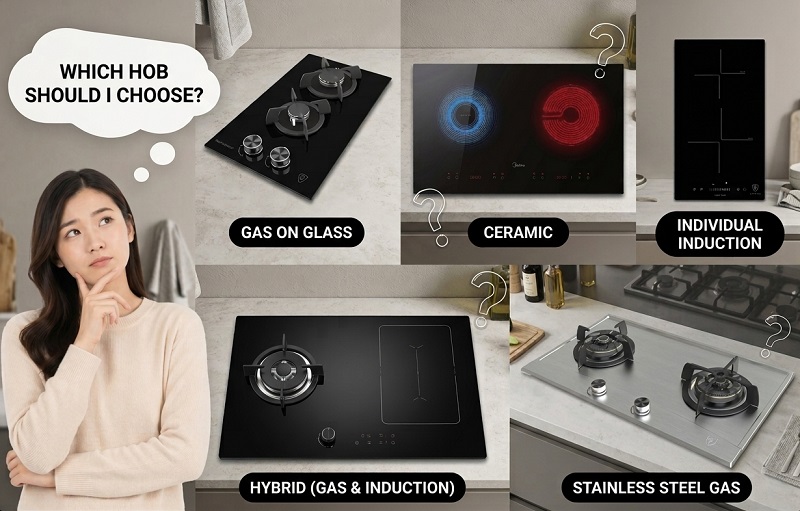
When choosing a cooker hob in Singapore, start with the type of cooking you do, then consider the number of burners, hob material, available space and safety features. Gas remains popular for wok cooking, while induction offers fast and precise electric cooking. Gas hobs are available in stainless steel or tempered glass, while vitro-ceramic hobs provide another electric option. For a new kitchen, also confirm your home's gas or electrical supply and make sure the hob fits your countertop cut-out.
Cooker hob types at a glance
There are three main types worth considering for a Singapore kitchen: gas, induction and vitro-ceramic.
Gas hob
A gas hob produces heat using a gas flame. It is a familiar choice for Singapore households, particularly for cooking with a wok, stir-frying and other high-heat cooking.
Gas hobs are available with different surface materials, most commonly stainless steel and tempered glass.
For the detailed decision between gas and induction, see our separate guide on gas hob vs induction hob.
Induction hob
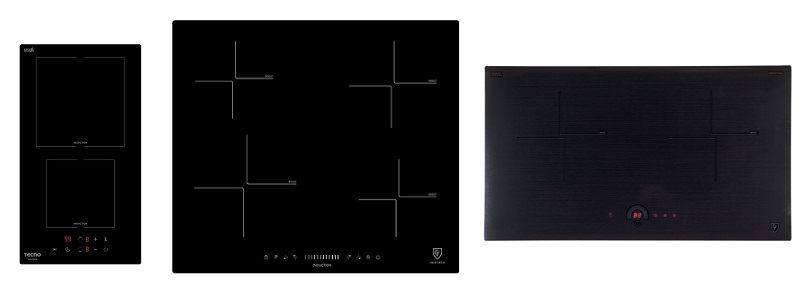
An induction hob uses electromagnetic heating to heat compatible cookware directly.
It provides fast heat response and precise control, with no open flame. However, you need induction-compatible cookware with a suitable magnetic base.
Induction can be particularly attractive for homeowners who want a modern, easy-to-clean cooking surface.
Vitro-ceramic hob
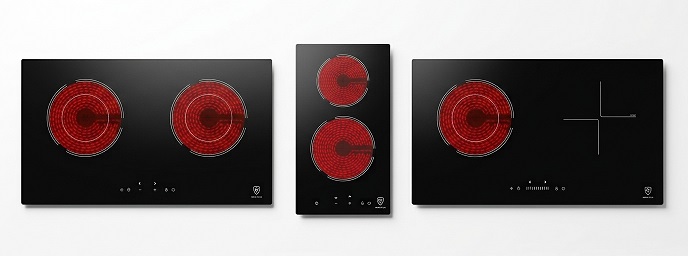
A vitro-ceramic hob, sometimes simply called a ceramic hob, uses electric heating elements underneath a glass-ceramic surface.
The cooking surface heats the cookware through the heating element rather than using electromagnetic induction.
It provides a clean, flat appearance and can work with a wider range of cookware than induction, but the cooking surface itself becomes hot during use.
Hybrid (gas and induction) hob
You may also come across hybrid hobs, which combine a gas burner and an induction zone in the same hob. These suit homeowners who want an open flame for the wok alongside the speed and easy cleaning of induction.
If you are deciding specifically between gas and induction, our separate gas vs induction guide goes into that comparison in greater detail.
How many burners do you need?
The number of cooking zones can make a big difference to everyday convenience.
2-burner hob
A 2-burner hob is a practical choice for smaller kitchens, compact BTO layouts or households that usually prepare one or two dishes at a time.
It also leaves more countertop space available.
A 2-burner hob may be enough if your usual cooking involves a simple combination such as a main dish and soup, or a wok and saucepan.
The trade-off is that you have less flexibility when preparing several dishes simultaneously.
3-burner hob
A 3-burner hob gives you more cooking flexibility.
You can have several pots or pans operating at the same time, which can be useful when preparing a larger family meal.
However, the actual usefulness depends on the layout of the burners. Three burners do not necessarily mean that three large pots can comfortably be used together.
Check the burner arrangement and spacing, particularly if you use a large wok or frying pan.
Burner types matter for Singapore cooking
Do not look only at the number of burners. Consider what each burner is designed to do.
For households that regularly cook with a wok, a high-heat wok burner can be particularly useful.
A stronger burner can provide the high heat needed for stir-frying and other cooking methods that benefit from intense heat.
A practical combination for some households is a high-heat wok burner together with smaller burners for saucepans, soup pots and lower-heat cooking.
The right arrangement depends on your cooking habits. If you rarely use a wok, having the strongest possible burner may be less important than having a layout that accommodates the cookware you use most.
Stainless steel vs tempered glass gas hob
If you have decided on gas, the next question may be the surface material.
Stainless steel gas hob

Stainless steel gives a more traditional kitchen appearance and is commonly associated with practical, hard-wearing cooking equipment.
It can be a sensible choice for households that prioritise straightforward functionality.
The surface can be cleaned, but food and grease may be more noticeable around the burners and pan supports. The design also tends to have more visible components than a flat glass surface.
Consider stainless steel if you:
- Prefer a practical, traditional appearance
- Want a surface that does not rely on glass
- Regularly do heavy cooking
- Do not mind spending more time cleaning around burners and trivets
Tempered glass gas hob
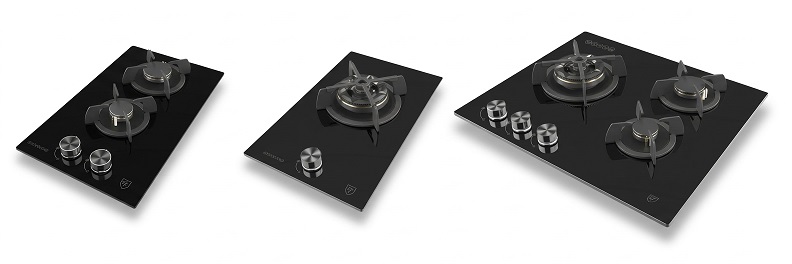
Tempered glass gives a cleaner, more modern appearance.
The smooth surface can make wiping away spills relatively straightforward. It can also blend neatly into a contemporary kitchen design.
However, glass still requires sensible care. Avoid treating the surface as indestructible, and follow the manufacturer's cleaning instructions.
Consider tempered glass if you:
- Prefer a modern appearance
- Want a smoother surface that is easier to wipe
- Like a cleaner, more integrated look in your kitchen
The choice between stainless steel and tempered glass is therefore not simply about appearance. Consider how heavily you cook and how you prefer to maintain your hob.
Hob size for HDB and BTO kitchens
Kitchen space is particularly important in Singapore, where many HDB and BTO kitchens have compact layouts.
Cooker hobs come in different widths, but as a practical guide, hob width should not exceed 86cm.
BTO kitchens typically use hobs around 56 to 76cm wide, although the appropriate size depends on your actual kitchen design and countertop.
A larger hob can provide more cooking space, but it also takes up more countertop area. Bigger does not automatically mean more useful if your kitchen is compact.
Most importantly, the hob needs to be compatible with your existing countertop cut-out.
If you are installing a new hob into a new countertop, the countertop should be prepared according to the manufacturer's specified dimensions.
If you are replacing an existing hob, do not assume that a hob of the same overall width will have the same cut-out requirements.
See our separate guide on how to measure your cooker hob and countertop cut-out for the detailed measuring information.
Safety features worth looking for
Safety features vary between models, so check the specifications before buying.
Flame failure protection
For gas hobs, flame failure protection is an important safety feature.
If the flame is accidentally extinguished, the system is designed to stop the gas supply to the burner.
This provides an additional layer of protection during everyday cooking.
Child lock
Induction hobs commonly offer a child lock function.
This can help prevent accidental operation of the controls, which is particularly useful in homes with young children.
The exact operation differs between models, so check the manufacturer's instructions.
Auto-ignition
Gas hobs with auto-ignition allow you to ignite the burner using the hob's ignition system rather than manually lighting the gas.
It makes everyday operation more convenient.
For gas hob installation and connection, always use a certified gas service worker. Do not attempt to carry out the gas connection yourself.
Cooker hob comparison
| Feature | Gas, stainless steel | Gas, tempered glass | Induction | Vitro-ceramic |
|---|---|---|---|---|
| Heat source | Gas flame | Gas flame | Electromagnetic heating | Electric heating element |
| Surface | Stainless steel | Tempered glass | Glass | Glass-ceramic |
| Wok cooking | Well suited | Well suited | Depends on model and cookware | Possible, depending on cookware |
| Cookware | Broad compatibility | Broad compatibility | Requires induction-compatible cookware | Broad compatibility |
| Appearance | Practical, traditional | Modern | Modern, minimalist | Modern, minimalist |
| Cleaning | More cleaning around burners | Smoother surface | Flat surface, generally easy to wipe | Flat surface, generally easy to wipe |
| Open flame | Yes | Yes | No | No |
| Key safety feature | Flame failure protection | Flame failure protection | Child lock on some models | Safety features vary |
| Best suited to | Heavy cooking and practical use | Gas cooking with a modern look | Fast, precise electric cooking | Simple electric cooking with broad cookware |
What should you choose?
There is no single cooker hob that suits every Singapore kitchen.
A gas stainless steel hob may suit you if practical cooking and heavy use are your priorities.
A gas tempered glass hob may be more suitable if you want gas cooking combined with a modern-looking surface.
An induction hob is worth considering if you want a flat, modern cooking surface with fast and precise electric heating, and you are prepared to use compatible cookware.
A vitro-ceramic hob provides another electric option if you prefer a flat cooking surface without the cookware requirements of induction.
Also consider how many burners you genuinely need. A compact 2-burner hob can be perfectly adequate for a smaller household, while a 3-burner arrangement may be more convenient for families preparing several dishes at once.
FAQ
What size cooker hob is suitable for an HDB or BTO kitchen?
BTO kitchens typically use hobs around 56 to 76cm wide. Hob width should not exceed 86cm. The correct choice depends on your available countertop space and the countertop cut-out.
Is a 2-burner or 3-burner hob better?
It depends on how you cook. A 2-burner hob saves space and can be sufficient for simpler cooking, while a 3-burner hob gives you more flexibility when preparing several dishes at once.
Which gas hob is better, stainless steel or tempered glass?
Neither is universally better. Stainless steel offers a practical, traditional appearance, while tempered glass gives a smoother, more modern look and can be easier to wipe clean. Your cooking habits and cleaning preferences should guide the choice.
Do I need a high-heat wok burner?
If you regularly cook with a wok, stir-fry or use high heat, a dedicated high-heat wok burner can be useful. If you mainly boil, simmer or cook with smaller pans, the burner arrangement and other features may matter more.
Final thoughts
Choosing a cooker hob in Singapore is about finding the right combination of cooking method, burner arrangement, material, size and safety features.
Think about how you actually cook at home. If wok cooking and high-heat frying are regular parts of your meals, pay attention to the burner type and layout. If your kitchen is compact, consider whether you really need three burners or a wider hob.
For gas, choose between stainless steel and tempered glass based on your preferred appearance, cleaning routine and everyday use. For electric cooking, consider whether induction or vitro-ceramic better matches your cookware and cooking preferences.
Finally, check your home's gas or electrical supply and make sure the hob is suitable for your countertop before purchasing. For gas installation, use a certified gas service worker.
Ready to choose? Browse our cooker hobs, induction hobs and vitro-ceramic hobs, and pair your hob with a matching cooker hood.
Related guides: How to Choose a Cooker Hood · Gas Hob vs Induction Hob.

Product tips and buying guides from the SG Appliances team.